Here's something that sounds backwards until you sit with it for a second: the best teams we've worked with treat building as the last step, not the first.
Think about that for a moment. Building feels productive. It feels like progress. You've got a Gantt chart, a Slack channel humming with activity, maybe a prototype someone's genuinely proud of. But progress toward what, exactly?
Every team is building something right now. A new product, a packaging refresh, a pricing model, a loyalty program, a campaign that has to land just right. And almost every one of those teams jumped into building before they'd really figured out what was worth building in the first place.
That's not a talent problem. It's a sequencing problem, and it's a lot more common than anyone likes to admit.
At Zibble, we call the fix Build Better. It's less a feature and more a mindset, one that's quietly reshaping how the sharpest product and marketing teams work with AI.
Most projects start the same way. Someone gets excited about an idea. The team rallies. A roadmap appears, almost out of nowhere. Meetings get booked. Research gets commissioned. Prototypes start taking shape.
And then, usually a few months in, the uncomfortable questions show up.
Is this actually solving the right problem? Would anyone real choose this over what they're already using? What are we assuming here that we haven't actually tested?
Here's the thing though: those questions shouldn't be showing up a few months in. They belong at the very start, before a single line of code gets written or a single mockup gets approved.
We'd go further, honestly. Confusing exploration with validation is probably the single most expensive mistake innovation teams make, and most don't even realize they're making it. Validation tells you whether something works. Exploration is what decides whether it deserves to be tested at all. Skip that step, and you're basically flipping a coin on which ideas get the expensive treatment.
You've lived this story, or something close to it.
Weeks poured into refining a concept that fizzled the moment it met real people. Months spent on a feature nobody asked for and, as it turns out, nobody wanted either. Packaging that looked stunning in the conference room and then disappeared on shelf, next to three competitors doing the exact same thing better. A campaign that felt airtight internally and landed with a shrug everywhere else.
None of this happens because the people involved are bad at their jobs. Quite the opposite, usually. It happens because the big decisions got locked in before anyone gave the ideas room to breathe, get challenged, and improve.
Innovation was never really about speed alone. It's about cutting down uncertainty before you spend real money finding out you were wrong.
Good teams ask better questions before they go chasing answers. Not complicated questions, just honest ones.
What are we assuming here? Which of these five concepts actually solves the biggest problem for the people we're trying to reach? What objections haven't we thought through yet? Would someone genuinely pay for this, or does it just sound good in a meeting? What's the blind spot nobody's mentioned yet, because nobody wants to be the one to bring it up?
Traditionally, answering questions like these meant scheduling research, recruiting participants, running interviews, and then waiting weeks to find out if your instincts were right. That work still matters enormously, and we're not suggesting you skip it. But there's a step now that can happen before all of that, one that used to be impossible at any real scale.
Picture the usual path. A team generates a handful of ideas, then jumps almost immediately into surveys, prototypes, or concept tests.
Now picture something slotted in between: a space where those same ideas get poked at, compared, and sharpened, all before a dollar of research budget gets spent.
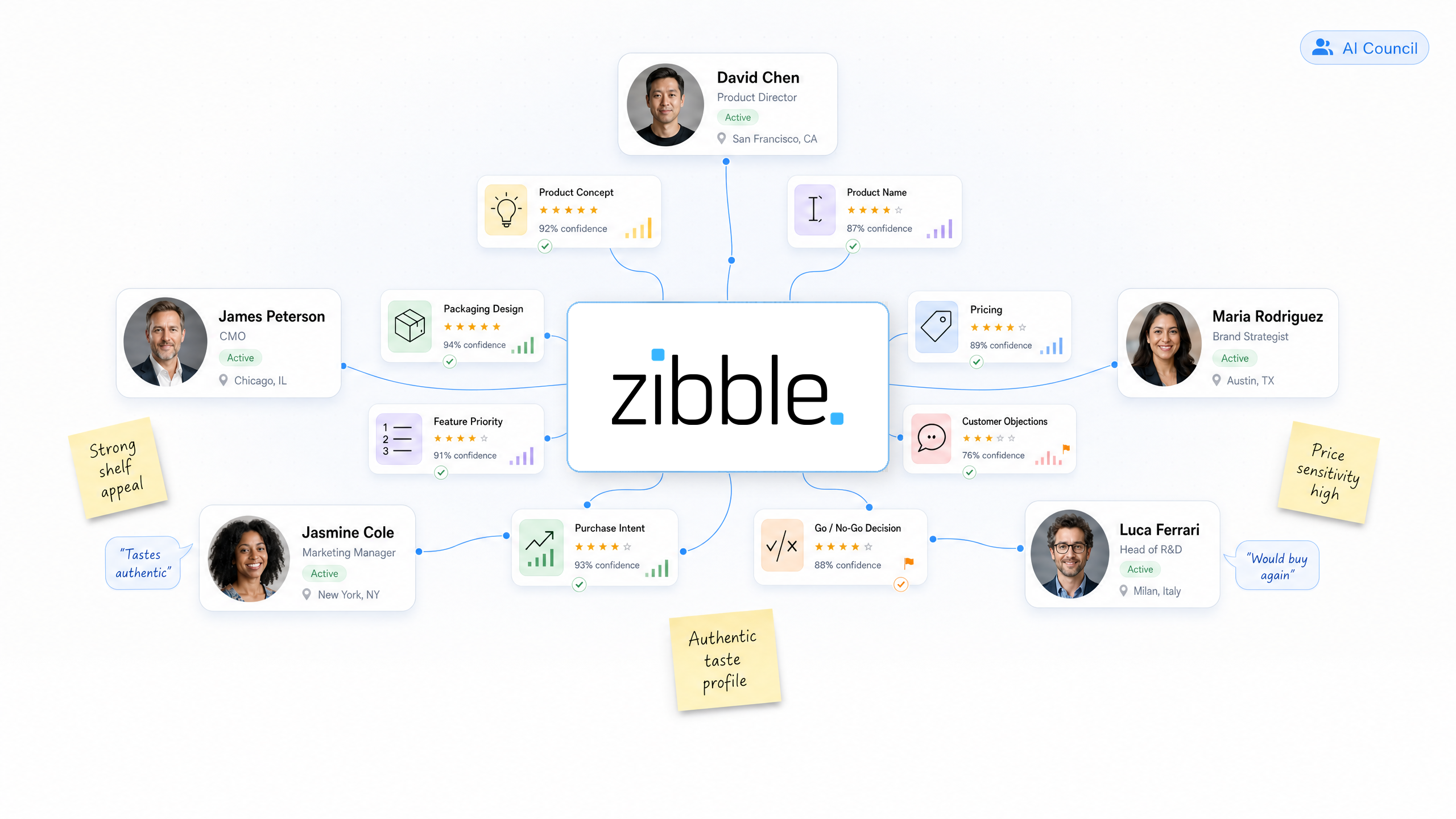
That's really what AI Personas are for. Not to replace the people you'd normally talk to, but to make the time you spend with them count for a lot more.
Say your team has five packaging concepts on the table. Marketing's convinced Concept A is the one. R&D keeps pushing for Concept C. Sales wants whatever feels safest to sell. Sound familiar? Now imagine bringing a dozen AI Personas into that same conversation before the meeting even starts, each one poking holes, raising objections, comparing the concepts against each other in ways nobody in the room had time to do manually.
Suddenly the meeting doesn't start with everyone defending their favorite. It starts with everyone looking at the same evidence.
Maybe two of those five concepts actually deserve to go into formal research, not all five. Maybe your questions get sharper because you already know where the soft spots are. You're not exploring blindly with real consumers anymore. You're validating the strongest bets you've got.
Explore with AI, validate with people, launch with confidence. Simple as that.
Here's a misconception worth clearing up: people assume AI Personas are a research team's tool. They're not, or at least, they shouldn't be treated that way.
Every function in the business makes decisions that start with an assumption, whether they'd phrase it that way or not. Innovation teams are betting on which product concepts have legs. Marketing is betting on positioning. Brand teams are betting that a piece of messaging will land the way they think it will. Packaging teams are betting on a design direction. Commercial teams are betting on a price point. Shopper marketing is betting a promotion will actually move the needle.
Different questions, sure. But it's the same underlying move every time: explore, challenge, improve, and only then move forward.
AI becomes less of a tool and more of a thinking partner here, one that helps every team walk into execution with a stronger case, not just the folks whose job title happens to include the word "research."
Explore → Align → Validate → Build
Explore with AI. Get the ideas out. Poke at the assumptions nobody's questioned yet. Compare the alternatives side by side, before any of them get precious.
Align as a team. Share what you found. Figure out, together, which opportunities are actually worth chasing. Get to a shared point of view before anyone commits real budget.
Validate where it counts. Now bring in consumer research, quantitative studies, prototypes, real market tests, aimed squarely at your strongest, most defensible bets instead of scattered across everything.
Build with confidence. Not because you got lucky, but because the thinking behind it actually holds up.
Better questions, in other words, tend to lead to better products. And better workflows tend to lead to organizations that just work better, full stop.
Give a team a better place to start thinking, and the whole process shifts. That's what AI is actually doing to innovation, quietly, in the background.
Instead of asking "what should we build," the sharper teams are starting to ask "what should we explore before we build." It sounds like a small shift in wording. It isn't. That one question, asked early and asked honestly, tends to lead to better conversations, tighter collaboration, sharper research, and products that actually hold up once they meet the real world.
This is the part most organizations miss. McKinsey's research found that companies capture only a fraction of AI's potential value unless they redesign the underlying workflow around it. Dropping a new tool into an old process doesn't move the needle much.
Organizations that actually redesigned their workflows around AI reported up to 80% higher productivity and development cycles that were up to 40% shorter. Those aren't marginal gains. The biggest improvements didn't come from better software. They came from better ways of working.
That's exactly where AI Personas fit into the picture. Rather than replacing human expertise, they give teams a way to explore more ideas, catch blind spots earlier, and make stronger decisions before committing serious time and budget to anything.
Whether you're developing a new product, evaluating packaging options, stress-testing a price point, or preparing for consumer research, every project starts with decisions. Lots of them, made quickly, often with incomplete information.
The shift that leading teams are making is surprisingly simple. Instead of asking "what should we build?", they're starting with "what should we explore first?"
That one question changes everything. It creates space to compare concepts before anyone gets attached to one. It surfaces the assumptions worth challenging. It lets you pressure-test ideas before they get expensive. And it means that when you do move into execution, you're moving with actual confidence, not just optimism.
Consumer research gets more focused because you already know where the interesting questions are. Meetings get more productive because the team is looking at evidence, not just trading opinions. Less time debating, more time learning. That's the shift.
NielsenIQ recently reported that 54% of shoppers already use AI when researching products before they buy. That's not a future trend. That's happening now, and it's accelerating.
NielsenIQ also notes that AI allows organizations to evaluate a much larger volume of ideas while reducing innovation timelines, helping teams generate insights at the speed of AI without sacrificing quality. For innovation leaders, that means exploring more possibilities upfront, so you can commit to fewer, stronger ideas downstream.
The teams that figure out how to explore faster will have a real advantage. Not because they're using AI, but because they're using it at the right moment in the process.
A 2024 study of more than 1,000 R&D scientists found that researchers using AI achieved 44% more discoveries, 39% more patent filings, and 17% more downstream product innovation. Those are significant numbers.
But here's what's interesting about how they got there. The researchers didn't succeed because AI replaced scientific thinking. They succeeded because AI expanded idea generation, which freed up experts to spend more time on the part only humans can do: evaluating, refining, and selecting the best opportunities.
That's the Build Better mindset in a nutshell. AI doesn't replace judgment. It gives great teams better starting points.
At Zibble, we think AI Personas shouldn't be something teams reach for at the end of a project, once the hard decisions are already made. They should be part of the first conversation. The first brainstorm. The first concept review. The first time someone asks, "are we actually solving the right problem here?"
Because the best innovation teams don't just build faster. They explore before they execute. They align before they invest. They validate before they launch.
Every better product starts with a better workflow. That's what Build Better is really about.
See how AI Personas can become the first real step in your team's innovation, marketing, and decision making, long before anyone touches a roadmap.
Sources
McKinsey & Company. What Makes Product Teams Effective? Analysis of more than 1,700 product teams across 75 organizations. mckinsey.com
McKinsey & Company. When AI Becomes Part of the Workflow: Redesigning How Software Gets Built. Reports organizations achieving up to 80% productivity gains and 40% shorter development cycles through workflow redesign. mckinsey.com
NielsenIQ. NIQ Unveils Groundbreaking AI Tools for CPG Brands. Discusses how AI enables brands to evaluate more ideas while accelerating innovation timelines. nielseniq.com
NielsenIQ. AI Is Resetting the Rules of Growth in CPG. Reports that 54% of shoppers use AI when researching products. nielseniq.com
Dell'Acqua, F., et al. (2024). The Impact of Generative AI on Research and Innovation. Study of over 1,000 R&D scientists demonstrating increased discoveries, patent filings, and downstream innovation with AI-assisted workflows. arxiv.org