AI archetypes and digital twins are often grouped together under the broad label of “synthetic consumers.” That shorthand is understandable, but it hides an important distinction. These approaches represent consumers differently, answer different kinds of questions, and require different standards of validation.
This is no longer just fashionable AI vocabulary. Established research companies are actively testing synthetic respondents, persona simulations, and consumer twins against human research. Their findings are promising in some contexts, cautionary in others, and consistent on one core point: the value is not in asking AI to impersonate a vague “target customer.” The value comes from matching the method, the data, and the validation approach to the decision at hand.
For innovation, product, brand, and insights teams, the practical question is simple: do you need to explore a demand space, or compare variation across individuals? The answer determines whether an AI archetype, a digital twin, or a combination of both is the more appropriate lens.
An AI archetype is a synthesized consumer perspective. It represents the reasoning, motivations, behaviors, tensions, and decision logic that may be shared across people within a defined consumer segment or demand space.
An archetype is not intended to stand in for one specific real person. It is a structured, research-grounded way to explore the point of view of a group: for example, a value seeker, a health-conscious shopper, a loyalist, or a buyer actively comparing alternatives.
This makes archetypes particularly useful for exploration. Teams can use open-ended questions to explore what a consumer segment may find compelling, what would create hesitation, which trade-offs matter, or where an initial proposition fails to meet a need. The aim is not to produce a final market-size estimate. It is to surface hypotheses, identify tension, improve the question, and give the team a more informed direction for the next step.
AI archetypes are designed to help teams explore the “why” behind a reaction.
The strongest uses are bounded by a clear segment definition and informed by high-quality human research. TRC Insights makes the related distinction explicitly: group-level digital personas can be powerful for inspiration and exploratory conversation, but they do not have a single individual’s ground truth against which they can be statistically validated.
A digital twin is an individual-level model built from data about a specific person or a set of specific people. Depending on the research design, that grounding can include survey responses, behavioral information, interview material, attitudes, demographics, and other relevant context.
Because a twin is associated with an individual profile rather than a synthesized group point of view, it is better suited to structured comparison. A team may ask every profile the same question such as a concept preference, purchase likelihood, or messaging choice, then compare the pattern of responses. The result is not just a single narrative about a segment; it is a view of distribution, difference, and potential outliers.
Digital twins are designed to help teams compare individual variation.
That individual grounding also creates a higher bar. Claims about twin quality should be tested against held-out human responses, not assumed from how natural a conversational answer sounds. TRC describes a project-level holdout approach that compares unseen twin answers with original human answers across means, top-box measures, and rankings. PSB’s appraisal of the Columbia Digital Twin research similarly warns that broad patterns can be preserved even when individual-level correspondence remains limited.
The difference between an archetype and a twin is not semantic. It changes the research job the model is being asked to perform.
| If the team needs to… | The more useful starting lens is… | The research output should emphasize… |
|---|---|---|
| Understand motivations, tensions, barriers, and opportunities within a defined demand space | AI archetypes | Reasoning, qualitative depth, hypotheses, and areas to probe further |
| Compare how different individual profiles respond to the same concept, message, or choice | Digital twins | Differences, rankings, response distributions, and decision-relevant variation |
| Make a high-consequence claim about a market, customer, or launch | Human research, potentially informed by either method | Direct validation with real people and explicit methodological controls |
Using an archetype as though it were a statistically representative individual panel can create false precision. Using digital twins to explore a broad, emerging demand space can unnecessarily narrow the conversation. The better approach is to begin with the decision uncertainty: what must be understood, what must be compared, and what still requires validation with people?
In many innovation programs, the two methods are complementary. Archetypes can help a team explore and improve multiple early ideas quickly. Individual-level profiles can then help pressure-test the most promising direction through a consistent set of structured questions. Human research remains essential when the decision requires confirmation, the category is genuinely new, the stakes are high, or the output will be used as market truth.
Five recent articles from established research and insights organizations demonstrate how the conversation has moved beyond generic AI claims. They also show why validation, data quality, and use-case discipline are non-negotiable.
Taken together, these sources do not support a simplistic claim that synthetic methods will replace research. They support a more useful conclusion: synthetic methods can make research systems more iterative, more targeted, and more responsive—provided they are grounded in relevant human data and validated for their specific job.
Zibble is designed around that more disciplined view. It is positioned as on-demand consumer intelligence for innovation decisions: an approach that starts with the business decision, sets a target consumer lens, returns a reasoned point of view, and enables teams to probe, refine, and test again.[6]
The system is not presented as generic AI that simply “knows about people.” Its documented approach is to structure the decision context, activate relevant intelligence, and reason through a specific consumer lens.[7]
Zibble’s Neural Synthesis Engine™ is as a connected system of ten intelligence layers, including query and intent analysis, persona initialization, dynamic context orchestration, cognitive prompt architecture, knowledge routing, data fusion, scenario reasoning, response synthesis, and persistent memory integration.[7]
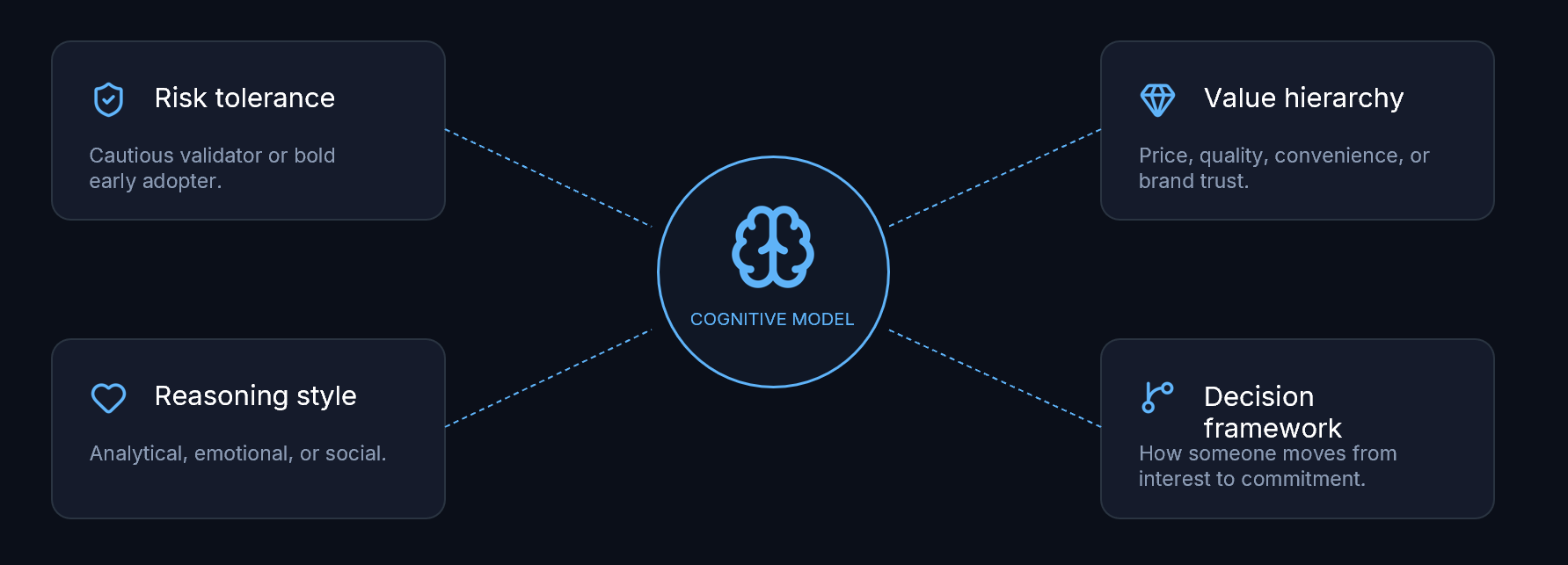
That architecture matters because consumer decisions are not driven by a list of facts alone. Zibble’s documented cognitive model considers dimensions such as risk tolerance, value hierarchy, reasoning style, and the decision framework through which a person moves from interest to commitment.[7] It combines established behavioral context with relevant current information, such as market, pricing, review, and other contextual inputs, when that information adds decision relevance.[7]
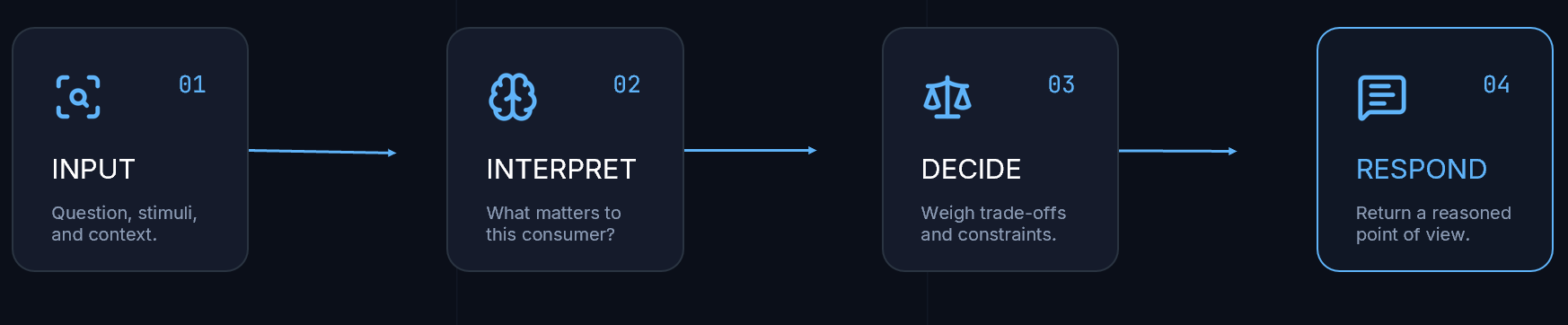
The result is intended to be a decision narrative rather than a generic answer. The platform’s scenario-based reasoning asks what an option means to a consumer, which trade-offs matter most, what could hold a decision back, and what would move someone forward.[7]
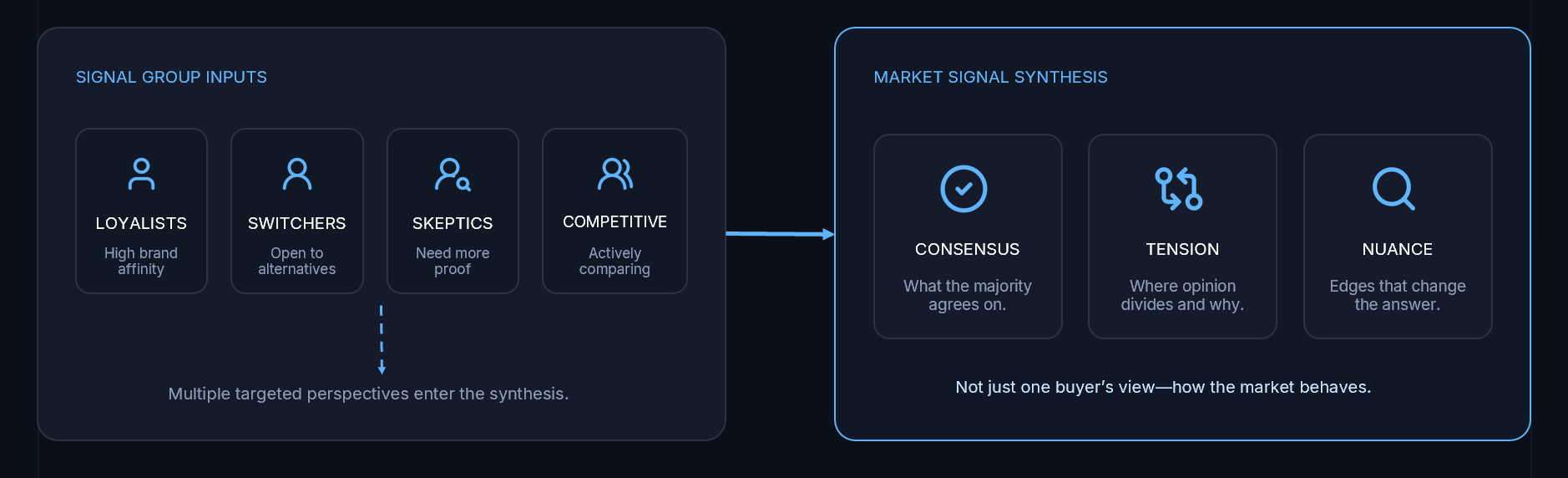
A single persona helps a team explore one targeted perspective. Zibble extends this through Signal Groups: multiple targeted persona perspectives synthesized to make three things visible: consensus, tension, and nuance.[7]
This is especially useful when a decision cannot be reduced to the average consumer. A loyalist, switcher, skeptic, and actively comparative buyer may respond to the same idea for different reasons. A Signal Group is designed to surface not only where the market agrees, but also where it divides, why the division exists, and which edge cases may change the recommendation.[7]
In this way, Zibble’s documented approach aligns with the central lesson from the research literature: do not mistake a fluent answer for a market signal. Build the consumer context, make the decision lens explicit, examine multiple relevant perspectives, and retain a clear line between exploratory simulation and research claims that require direct human validation.
Zibble’s attached validation report describes personas that are matched to live participant profiles using established segmentation and psychographic frameworks. The reported matching inputs include demographics, psychographic profiles, behavioral patterns, category involvement and experience, and cultural and contextual factors.[8]
The goal is not to create an abstract, generalized consumer. The report describes matched AI personas being exposed to the same research objectives, discussion guides, stimuli, and questioning frameworks as their human counterparts.[8] That is an important distinction from basic persona prompting: it creates a like-for-like comparison structure in which the AI output can be assessed against a relevant human benchmark.
Zibble’s validation report documents a multi-sector program conducted from May 2024 to February 2025. It reports benchmarking against 57 moderated focus groups, IDIs, and one-to-one interviews, with additional historical benchmarking drawn from three years of Fresh Intelligence qualitative research outputs across B2C and B2B contexts.[8]
The report describes a parallel research design: live qualitative research was conducted using standard protocols, and matched AI personas were given the same objectives, stimuli, discussion guides, and questioning framework. The resulting human and AI outputs were collected independently, anonymized and randomized, then assessed through blind comparative review by multiple evaluators.[8]
Its evaluation framework included semantic similarity and response-pattern correlation, consistency of decision logic and value expression, emotional tone and motivational drivers, and the depth, specificity, and actionability of the insight.[8] The report states that Zibble achieved 90–95% alignment with human-derived qualitative insights across the program, and describes stability over a nine-month testing period.[8]
That figure should be read precisely. It is Zibble’s reported alignment outcome from its documented qualitative validation program; it is not a universal accuracy claim for every model, category, question, or future decision. This is the kind of discipline the external literature calls for: define the test, establish a relevant human comparator, make the evaluation criteria explicit, and be transparent about the scope of the result.
AI archetypes and digital twins are not interchangeable, and neither is a replacement for well-designed human research. They are different tools for different moments in the decision process.
Use AI archetypes to explore a pre-defined segment or demand space: to learn where an idea resonates, where it creates tension, and what questions deserve deeper investigation. Use digital twins to compare how grounded individual profiles may respond to the same structured question. Use human research to validate important conclusions, investigate emerging behavior, and make high-stakes choices with confidence.
Zibble offers an in-depth persona-simulation approach built around decision context, cognitive modeling, relevant intelligence, scenario-based reasoning, and market-level synthesis. Its reported validation program is designed to hold that approach to the same standard that matters most: whether the resulting insight meaningfully aligns with the human research it is intended to inform.[7] [8]
If your team is making product, proposition, packaging, messaging, pricing, or prioritization decisions before the next formal research moment, the right question is not simply, “Can AI answer this?” It is: which consumer lens will reduce uncertainty responsibly—and what must still be validated with people?
[1] Kantar — What is synthetic sample—and is it all it’s cracked up to be?
[2] Radius Insights — AI and Synthetic Respondents: 3 Case Studies with MilkPEP
[3] TRC Insights — Synthetic Data, Digital Twins & Digital Personas
[4] PSB Insights — Digital twins, synthetic data, and how to not fool yourself
[5] Ipsos — Transforming Research Through Synthetic Data
[6]: Zibble — Decision Intelligence on Demand, request the deck
[7]: Zibble — The Neural Synthesis Engine™, request the deck
[8]: Zibble Platform Validation: Comprehensive Review, request the whitepaper