Most ideas do not fail because they were foolish. They fail because nobody challenged them hard enough before they went live.
A founder gets excited. A team gets attached. A few trusted people say, “This sounds great.” Maybe the messaging is polished, the concept feels timely, and the internal energy is high. But once the idea meets the real market, the cracks appear fast. People do not understand it. They do not care enough. They do not switch. They do not buy.
That gap between internal confidence and external reality is where Signal Group comes in.
Signal Group is a structured way to pressure-test an idea before launch. Instead of relying on vague validation, polite feedback, or a single customer lens, it puts your concept in front of multiple distinct viewpoints at once. Some are buyers. Some are strategists. Some are skeptics. Each one evaluates the
idea from a different angle, challenges the others, and helps reveal whether what you have is genuinely strong or just emotionally compelling.
The goal is not to make you feel good about your idea. The goal is to find out whether it can survive real scrutiny.

Traditional feedback tends to be too soft.
Friends and colleagues are often supportive rather than rigorous. Surveys can tell you what people say, but not always what they would actually do. A brainstorm can generate possibilities, but it rarely exposes the real points of resistance that kill momentum in-market.
Even customer interviews have limits if you only hear from one segment, or if you frame the question in a way that invites encouragement rather than criticism.
What founders and marketers usually need is not more reassurance. They need better friction.
They need to know:
who immediately sees the value
who does not believe the promise
what objections show up first
where the positioning is weak
whether the offer feels differentiated
what makes someone switch, hesitate, or walk away
That kind of insight does not come from asking, “Do you like this?” It comes from structured disagreement.
Signal Group is a multi-perspective idea evaluation framework.
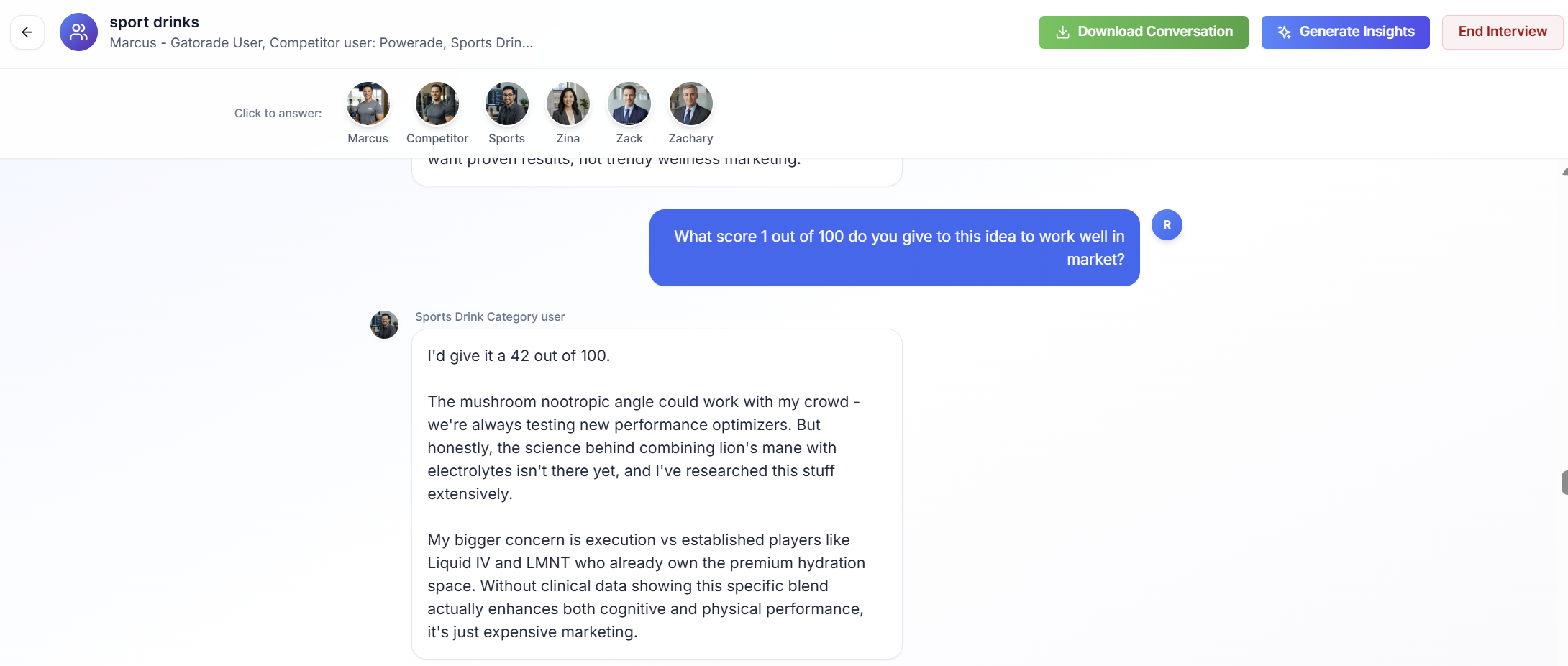
At its core, it simulates a live discussion between several distinct personas, each representing a meaningful market or strategic viewpoint. These personas do not simply react in isolation. They respond, disagree, push back, expose assumptions, and test whether the idea holds up under pressure.
The result is not a generic summary. It is a sharper, more realistic read on how your idea may perform when it encounters actual buyer psychology, competitive alternatives, and strategic scrutiny.
Signal Group is useful for pressure-testing:
product ideas
offers
positioning
messaging
pricing
launch concepts
service packages
brand extensions
content-driven business ideas
If you are deciding whether to launch, refine, reposition, or abandon something, Signal Group is built for
that decision.
The strength of Signal Group comes from the range of viewpoints involved.
A strong idea should not only appeal to people already inclined to like it. It should also withstand skepticism, comparison, and strategic analysis. That is why Signal Group includes multiple roles.
Brand Loyalist
This is the person who already trusts your brand or naturally aligns with it. They help surface whether
the idea strengthens the relationship or feels off-brand, unnecessary, or diluted.
Category Buyer
This person buys in your category, but not necessarily from you. They are useful for testing mainstream
relevance and whether your offer is compelling enough to earn consideration.
Competitor Buyer
This is someone already buying from an alternative. Their perspective helps reveal switching barriers,
comparative weaknesses, and whether your differentiation is strong enough to matter.
Rejector
The rejector is not sold on the category or the concept in the first place. This voice is especially valuable
because it surfaces the objections many teams avoid hearing until too late.
Business Strategist
This persona looks beyond appeal and asks harder commercial questions. Is the market large enough? Is
the idea defensible? Is there a believable path to traction, margin, and growth?
Marketing Consultant
This perspective evaluates positioning, message clarity, perceived relevance, memorability, and whether the concept has real pull in the market.
Together, these personas create a more realistic test environment than a single user profile or a shallow “target audience” summary ever could.

Each persona reacts to the concept from its own standpoint. The point is not consensus. In fact, disagreement is one of the most useful parts of the process. When one persona sees strong upside and another sees major risk, that tension usually reveals where the offer is either differentiated or fragile.
From there, the group pushes deeper:
What is working?
What is unclear?
What feels overpromised?
What feels genuinely attractive?
What would stop adoption?
What would improve conversion?
What is strategically weak even if it sounds exciting?
At the end, each persona delivers a final view, including the strongest argument for the idea, the strongest argument against it, a recommendation, and a probability score. Those scores are then weighted into one final Signal.
That final Signal is not meant to be magic. It is meant to be decision-useful.
There are plenty of ways to get feedback. Most of them are either too broad, too polite, or too shallow. Signal Group is different because it is built around tension. It does not assume that one audience reaction tells the whole story. It does not collapse everything into bland positivity. It does not treat “interesting” as the same thing as “viable.” Instead, it is designed to do three things well.
First, it creates perspective contrast. A loyal customer, a competitor’s buyer, and a strategic operator will not judge the same idea the same way. That divergence is useful. Second, it forces specificity. Signal Group works best when the offer, audience, and context are clear.
That alone improves the quality of thinking. Third, it produces decision-grade insight. Not just impressions, but structured strengths, weaknesses,
risks, and next-step recommendations. In practical terms, it helps answer questions like:
Is this idea clear enough?
Is it differentiated enough?
Is it relevant to the audience we think it is for?
Are we underestimating resistance?
Is the promise strong, or just dressed up well?
What needs to change before this goes to market?
One of the most useful outcomes of Signal Group is not a “yes” or “no.” It is the quality of the flaws it exposes.
Sometimes the offer is strong, but the positioning is generic.
Sometimes the messaging is compelling, but the economics do not make sense.
Sometimes the business case is attractive, but the buyer motivation is too weak.
Sometimes one segment loves the concept while another sees it as confusing, risky, or irrelevant.
That is the value of pressure-testing. It helps separate:
emotional attachment from market appeal
novelty from differentiation
clarity from assumption
enthusiasm from readiness
And when an idea does have real strength, Signal Group helps identify exactly where that strength lives so you can lean into it harder.
Signal Group is for people making bets. Founders can use it before building or launching. Marketers can use it to stress-test campaigns, offers, and positioning. Consultants can use it to sharpen recommendations before taking them to clients. Teams can use it to challenge internal consensus and uncover blind spots early.
It is especially useful when:
you are close to an idea and need outside rigor
your team agrees too quickly
the market is competitive
the offer depends on switching behavior
the messaging feels promising but unproven
the cost of a weak launch would be high
The earlier you find friction, the cheaper it is to fix. The real purpose of pressure-testing
A lot of people hear critique as a threat to the idea. That is the wrong frame.
Good pressure-testing does not exist to kill momentum. It exists to make the idea more resilient.
Sometimes that means confirming the concept is stronger than expected. Sometimes it means refining the audience, tightening the message, or changing the offer structure. Sometimes it means realizing that what looked exciting was never going to land.
All of those outcomes are useful. Because the market will test your idea eventually. The only question is whether you want that test to happen before or after you invest in the launch.
Signal Group exists for one reason: to help ideas face reality early.
Not through random opinion. Not through generic praise. Through structured, conflicting, market-relevant perspectives that expose what is strong, what is weak, and what deserves another round of thinking. If you are building something new, the smartest move is not to ask whether people like the idea. It is to ask whether it can hold up when smart, skeptical, varied perspectives push on it from all sides.
That is what Signal Group is built to do.